Public accessibility is not a reuse licence. Platform terms can limit downloading, storage, redistribution, automated access and account use even when a video is visible to everyone. Copyright may separately limit copying, adaptation, sharing and public performance.
This is general information, not legal advice. This article does not summarize the current rules of any named platform. Terms change frequently; read the official current version for the service you use.
Terms are separate from copyright
Copyright law grants rights to authors and other rights holders. A platform’s terms are a contract that governs your use of the service. Complying with one does not automatically satisfy the other.
A platform may permit you to view a video in its player while restricting downloads, copying, automated access or redistribution. Even if copyright law would allow a particular use, the contract may impose additional conditions. Conversely, a platform feature that enables a download does not necessarily grant copyright permission to republish the work.
Terms can also incorporate other policies, guidelines or licence terms. The operative document may be longer than the main terms page, and the version that applies can depend on your account, region or the date you used the service.
Viewing, downloading, storing, sharing and re-uploading
These are different actions with different consequences. Watching a video through a platform’s player is not the same as making a local copy. Saving a file for offline viewing is not the same as distributing it. Re-uploading a file to another service can reach a new audience and may implicate distribution or communication rights.
A platform may offer an official offline or download feature with its own limits. That feature is not evidence that third-party download tools are permitted, nor that the file can be edited, monetized or republished.
Editing adds another layer: it may create an adaptation or remix, and it may require permission from the copyright owner and any performers or music rights holders. Platform terms may separately restrict modified versions.
| Action | What to check |
|---|---|
| View in the platform | Account and service terms; no copy is made |
| Use an official offline feature | That feature's limits and expiry |
| Download with another tool | Platform terms, copyright and access restrictions |
| Store or back up | Whether a copy is permitted and for how long |
| Share or re-upload | Distribution, audience, platform rules and rights |
| Edit or monetize | Adaptation, commercial-use and attribution rights |
Why public does not mean reusable
A public post is visible, not abandoned. The creator may still own copyright, and the platform may still impose contractual limits on copying or redistribution. “Public” describes access, not the legal rights attached to the work.
A video can also contain third-party material: music, stock footage, a performance, a trademark or a person’s image. The uploader may not control all of it. Public visibility does not resolve those layers.
Attribution, a disclaimer or a “no copyright infringement intended” note does not replace permission. Those statements may show good faith, but they do not create a licence.
How to find and read the current terms
Start from the platform’s official website, not a search-result copy or a third-party summary. Look for links labelled Terms of Service, Terms of Use, User Agreement or Legal in the footer or help centre. Check the effective date and whether the page includes regional variations or links to additional policies.
Search the document for terms about downloading, copying, scraping, automated access, redistribution, commercial use, account termination and intellectual property. Read the definitions and exceptions, not only a single sentence. If the terms incorporate a separate acceptable-use or copyright policy, read that too.
Save or cite the exact version and date you relied on. If the terms change later, your earlier use is not necessarily governed by the new text, but a continuing or new use may be. Do not treat a summary article as the contract.
Terms and conditions often use defined terms and cross-references. Read the definitions for “content,” “service,” “download” and “commercial use” instead of assuming the ordinary meaning.
A platform may publish separate developer, API or offline-access terms. Those documents can differ from the general consumer terms and may impose additional limits.
Technical capability is not permission
A download button, a browser feature, a developer tool or a publicly accessible media URL can make a copy technically possible. Capability does not equal contractual or legal permission.
Do not bypass DRM, paywalls, login requirements, age gates or other access controls. A tool that can retrieve a stream is not a legal opinion, and a platform’s technical measures may be protected separately from the video’s copyright.
If a feature is officially offered, read its scope. An offline download that expires in an app is different from a permanent file you may redistribute. “Available for offline viewing” is not a synonym for “licensed for reuse.”
Account requirements, automation rules and rate limits can also affect whether a download is permitted. A tool that works without logging in does not thereby satisfy every contractual condition.
Document permission and respect restrictions
Keep the video URL, the creator or rights holder, the permission or licence, the date, the intended use and any conditions. A written message that grants only personal viewing is not permission to publish. A stock licence may limit audience, territory, duration or media.
If you cannot identify a permission, do not assume that a public link is enough. Use a different source, seek a licence or ask the rights holder. Record the answer and follow any credit, deletion or reporting conditions.
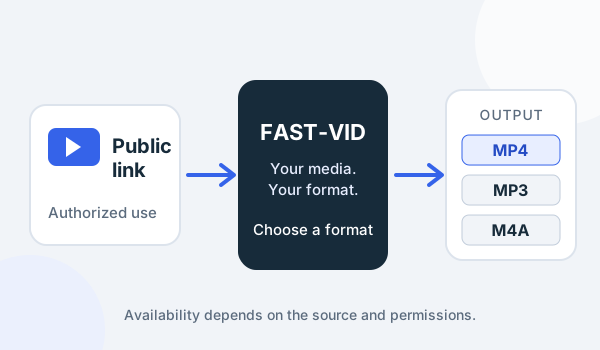
FAST-VID is a public-link downloader and does not grant platform, copyright or reuse rights. It does not override terms, access controls or DRM. Use it only for content you own or are authorized to save.
The downloader you use has its own terms and privacy policy too. A tool cannot authorize reuse that the source platform or rights holder has not granted.
Frequently asked questions
If a video is public, can I download and reuse it?
Not necessarily. Public visibility is not a licence. Copyright and platform terms may still restrict downloading, sharing, editing and re-uploading.
Are platform terms the same as copyright law?
No. Terms are a contract with the service; copyright is a separate legal framework. Complying with one does not guarantee compliance with the other.
Does an official download feature grant reuse rights?
Not usually. It may permit offline viewing within the app under specific limits, not editing, redistribution or commercial use.
Where should I read a platform’s terms?
Use the platform’s official site or help centre, check the effective date and read incorporated policies. Do not rely on a third-party summary.
Does FAST-VID grant permission to reuse a video?
No. FAST-VID only downloads supported public links. It does not grant copyright, platform or reuse rights.
Sources and references
- YouTube: Terms of Service
- TikTok: Terms of Service
- Instagram: Terms of Use
- WIPO: Copyright
- FAST-VID: Copyright and video downloads
Try FAST-VID
Open the FAST-VID downloader for a supported public link. Read the source platform’s current terms and use only content you own or are authorized to save.