Fair use and fair dealing are legal doctrines, not editing shortcuts. They can permit limited uses for purposes such as criticism, review, education or news reporting, but the result depends on the law that applies, the work, the amount used and the effect of the use. Public availability and a credit line are not substitutes for permission.
This article is general information, not legal advice. Copyright rules vary by country and by the facts of a specific use. Consult a qualified lawyer or the relevant rights holder when the answer matters.
What copyright exceptions are
Copyright gives rights holders control over certain uses of a work, such as copying, distributing, adapting and communicating it to the public. Most countries also define exceptions or limitations that permit some uses without authorization, subject to conditions.
An exception is not a general licence to use anything for any purpose. It may apply only to certain categories of use, require attribution, require lawful access, or prohibit commercial substitution for the original. The scope differs significantly between countries.
Because the rules are territorial, the fact that a use might be permitted where you live does not automatically settle the law where the work was created, where the rights holder is based, or where the audience is located.
The US fair-use framework
US fair use is a flexible, fact-specific doctrine. Courts generally consider four factors together rather than applying a checklist with a pass mark:
1. Purpose and character of the use. Is it commercial or nonprofit educational? Is it transformative, adding new meaning or commentary, or merely substituting for the original? Noncommercial and educational uses can still weigh against a finding depending on the other facts.
2. Nature of the copyrighted work. Factual or published works may be treated differently from highly creative or unpublished material, but this factor is rarely decisive alone.
3. Amount and substantiality. How much was used, and was the portion qualitatively important? A short clip can be the “heart” of a work; a longer excerpt can sometimes be reasonable for the purpose.
4. Effect on the potential market or value. Does the use substitute for the original or harm licensing opportunities? This factor often carries significant weight.
These factors are not a formula. A court may reach different results on similar lengths or purposes. The US Copyright Office states that there is no legal rule permitting a specific number of words, musical notes or percentage of a work.
Fair dealing in the UK and Canada
Fair dealing is a different approach. It generally starts with a defined list of permitted purposes and then asks whether the dealing is fair. It is not the same open-ended test as US fair use.
In the UK, exceptions cover specific purposes such as criticism, review, quotation, news reporting and parody or pastiche, with conditions that can include sufficient acknowledgement. A dealing must fit the relevant exception; calling a use “educational” does not automatically bring it within one.
In Canada, fair dealing applies to listed purposes that include research, private study, education, parody, satire, criticism, review and news reporting. The Canadian Intellectual Property Office notes that the source and author must be named for fair dealing. A fairness assessment still follows, and only a court can decide whether a particular dealing qualifies.
Other countries use different exceptions, such as quotation, criticism, teaching or incidental inclusion. Do not assume that a US fair-use analysis transfers to the UK, Canada or anywhere else.
Common assumptions that do not settle the question
“It is educational.” Education can be relevant, but it does not automatically make a use fair. Teaching, commercial courses and public uploads can involve different facts.
“It is noncommercial.” Lack of payment helps in some analyses but does not decide the outcome. A free upload can still substitute for the original or harm a market.
“I gave credit.” Attribution is important and may be required by a licence or exception, but it does not replace permission or create a right to use the work.
“It is only a short clip.” Length is one fact, not a safe harbour. Using the most important moment, the original audio, or a clip that replaces the need to view the source can weigh heavily against fairness.
“It is public.” Public accessibility is not a licence. A work can be publicly visible and still protected by copyright and platform terms.
Downloading, copying, sharing, adapting and displaying
Different actions implicate different rights. Watching a video in a platform's player is not the same as downloading a copy, storing it, editing it, uploading it elsewhere or showing it publicly. A permission for one action may not cover another.
Downloading creates a copy. Sharing a file may distribute it. Re-uploading can communicate it to a new audience. Editing may create an adaptation. Public screening can implicate performance or communication rights. Each step needs its own analysis, and platform terms may add contractual restrictions on top of copyright.
A licence that allows downloading does not necessarily allow public performance, monetized distribution or sublicensing. Read the scope, not only the word “free.”
| Action | Question to ask |
|---|---|
| Download or copy | Does an exception or licence permit reproduction? |
| Share a file | Does it permit distribution to this audience? |
| Re-upload | Is the platform use allowed, and is the audience new? |
| Edit or remix | Does it permit adaptation or derivative work? |
| Public screening | Is a performance or communication right involved? |
A practical assessment workflow
Start by identifying the work, the rights holder and the law likely to apply. Check whether the source itself grants a licence, such as a Creative Commons licence, and whether that licence covers your intended use. A platform's terms may separately restrict downloading or reuse.
Describe the proposed use precisely: the exact clip, duration, transformation, audience, platform, commercial context and distribution. Then ask whether a specific exception plausibly applies and whether the use is limited and necessary. If the answer is uncertain or the use is central to your product, seek permission.
Keep a record of your reasoning, the licence or permission, and the version of the terms you relied on. Do not rely on a generic “fair use” label in an upload form as proof that the use is lawful.
If you need permission, ask before publishing. A response that grants only downloading may not grant editing or commercial reuse.
When to seek permission
Permission is the clearest path when an exception is uncertain, when the use is commercial, when you need the whole work, when the clip is the main value of your project, or when you plan to redistribute the file. A licence may also be available through a collective or stock provider.
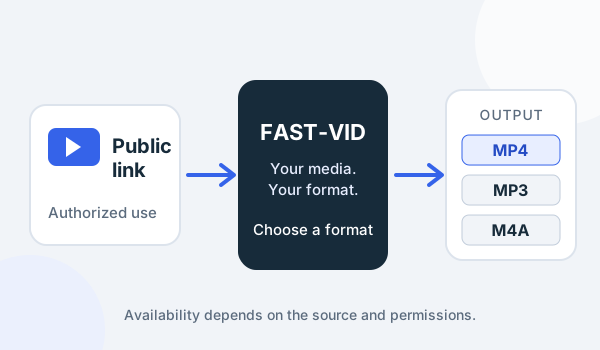
FAST-VID is a public-link downloader, not a rights-clearing service. Using it does not grant copyright, platform or reuse rights, and it does not make a restricted or private video public. Download only content you own or are authorized to save.
When in doubt, ask the rights holder and keep the written answer. A clear “no” is useful information; proceeding anyway is not a fair-use strategy.
Frequently asked questions
Is fair use the same in every country?
No. Fair use is a US doctrine. The UK, Canada and other countries use different exceptions, including fair dealing, with different purposes and conditions.
How many seconds of a video can I use?
There is no universal permitted number of seconds or percentage. Courts and exceptions consider purpose, amount, effect and other facts.
Is educational or noncommercial use automatically allowed?
No. Those facts can matter, but they do not automatically make a use lawful. The work, amount, market effect and applicable exception still matter.
Does crediting the creator make reuse legal?
No. Attribution may be required, but it does not replace permission or create a licence.
Does downloading a public video give me reuse rights?
No. Public visibility is not a licence. Copyright and platform terms can still restrict downloading, sharing, editing and re-uploading.
Sources and references
- U.S. Copyright Office: Fair Use
- U.S. Copyright Office: Fair Use FAQ
- UK Government: Exceptions to copyright
- Canadian Intellectual Property Office: Copyright basics and fair dealing
- WIPO: Copyright
- FAST-VID: Copyright and video downloads
Try FAST-VID
Open the FAST-VID downloader for a supported public link. FAST-VID does not grant copyright, platform or reuse rights; use content you own or are authorized to save.